7th Street Development Stormwater Update
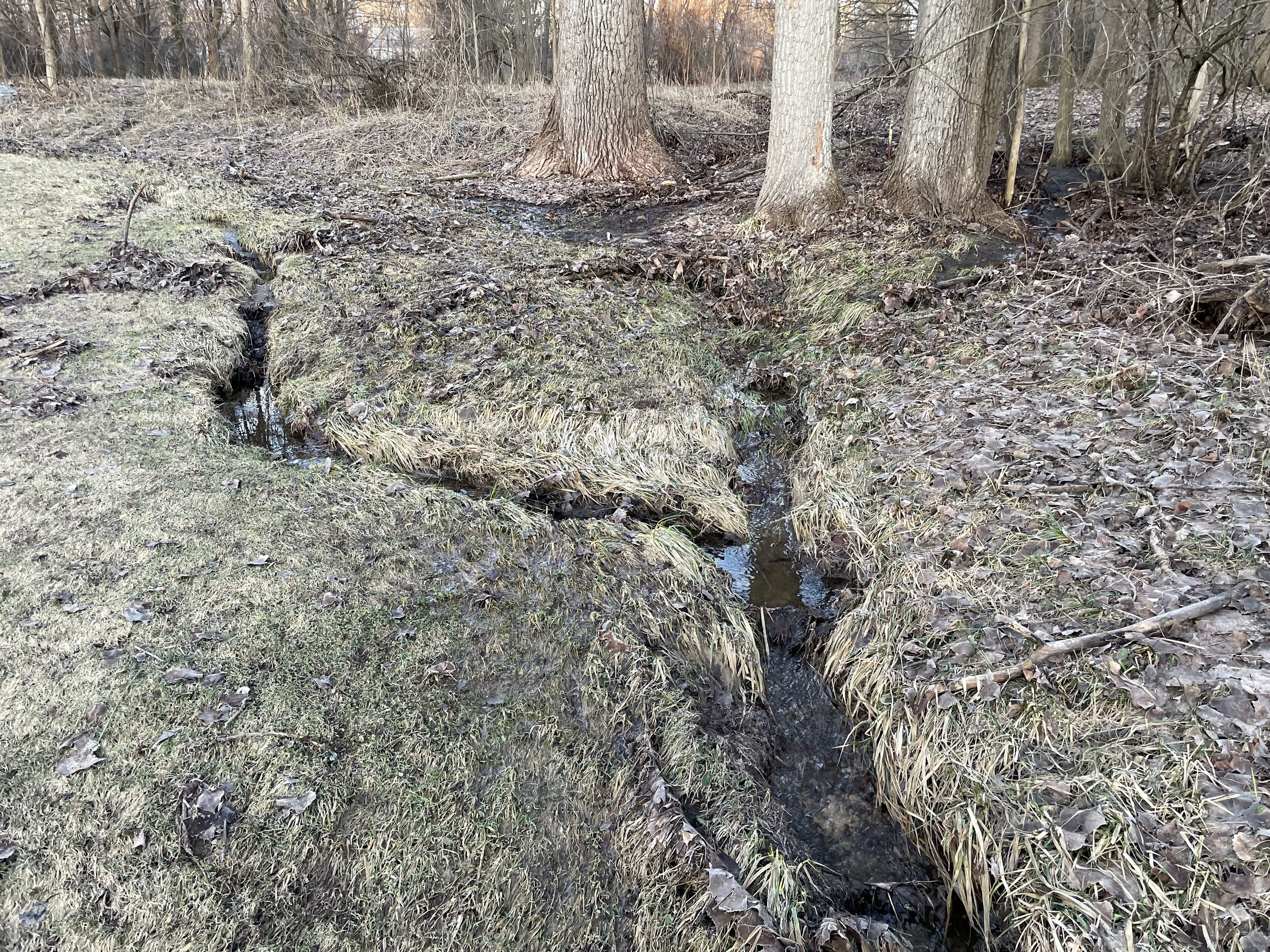
Two streams channeling water from the lot at 2450 Seventh Street NW onto neighboring properties, April 2026
Several of us whose properties border the development site at 2450 7th NW were invited to meet with Justin Longstreth from Moore + Bruggink, the engineering firm hired by Adam Rogalski to design the lot’s stormwater management features. Adam was also there.
Here are some key takeaways from the meeting.
Stormwater management
The developer is putting in a stormwater basin designed to handle a 25-year rain event. This is a significant reduction from the 100-year rain event we were initially told they would design for.
A 25-year rain event amounts to 4.66 inches of rain in a 24-hour period. For reference, the heaviest rainfall we received in one 24-hour period last spring was somewhere between 3 and 4 inches. So we’ve already almost had one 25-year rain event this year.
There will actually be three stormwater connection points on the property, including one they claim will collect water from the undeveloped part of the lot. However, this claim has to be balanced with the fact that there are features of this lot they were clearly unaware of.
The engineering firm also says the stormwater basin will improve water flow through the ditch that channels water east to city drainage system, because the release of water from the basin will be managed. We were showed before-and-after calculations of the expected water flow as evidence. However, these are merely projections. When asked if the developers would take any measurements after construction to confirm whether their projections were accurate, they had no answer.
The main stormwater basin on the eastern edge of the lot will have a berm separating it from the neighboring lot(s). It will be enclosed by a 4-foot tall chain link fence.
Bottom line: The stormwater basin is likely capable of managing a good deal of rainwater. But its effectiveness could be compromised by groundwater (see below) and other concerns. We’re also being asked to take their word for it that stormwater issues will be handled—without any clear means of accountability if they’re not. Finally, while artificial stormwater basins can manage large amounts of water, they cannot do all the things natural wetlands do—namely, filtering toxins and pollutants out of the water supply.
Natural water features
The stream running along the southeast corner of the lot will not be connected to the stormwater basin. Which means water from this stream will continue to flood neighboring properties. The developers’ rationale for this is twofold:
The stream originates from a pipe on a neighboring property. The pipe is the discharge point for a stormwater basin on the lot owned by Grand Rapids Public Schools. The developer claims to have reached out to GRPS, who has declined to do the necessary maintenance work on a stormwater system that is actively failing.
The developer claims the area around the stream is a wetland, prohibiting them from making improvements to the stream. However, the delineation does not appear to identify this area as wetland. The engineering firm is aware of this discrepancy and has promised to follow up.
More concerningly, the developers were completely unaware of the existence of a second, intermittent stream that originates on their property—despite the obvious contours on their own map showing the defined banks that indicate the presence of a stream. They claim the stormwater basin will catch water from this stream.
Bottom line: The developers’ plans do not adequately address drainage and flooding issues caused by the streams on the southeastern portion of the lot.
Wetland buffer
I asked the developers point blank if there was any rationale for requesting a 67% reduction to the legally required wetland buffer, other than not having to reduce the footprint of the development. Their response: “Well, we have to make money on this thing.”
In other words, profit is their only motivation for trying to get out of their obligation to protect the natural wetlands on this site.
In addition, the developers told us that if the city denies their request to reduce the buffer, they will seek a permit from EGLE to fill the wetlands instead. If granted, they claim this would effectively eliminate any need for a buffer, because state regulation supersedes local zoning ordinance.
Bottom line: This is a veiled threat: If you don’t let us build what we want, we’ll get the state to let us kill the wetlands so there won’t have to have any buffer. It’s unclear how likely EGLE is to grant such a request. But it’s important for the Planning Commission to know the developers will try to go around them to get what they want, if that’s what it takes.
Groundwater presence
The developers have not done their due diligence to investigate potential groundwater on the site, despite plenty of evidence:
Flooding problems among homes at higher elevation along Fairfield
Erosion of the slope along the western edge of the lot
Skunk cabbage, a plant commonly found where groundwater is present
The developer says a groundwater assessment will be done after the special land use request is granted. We urged them to sample areas throughout the site, not just one or two locations.
Bottom line: This is a high-risk approach for the developers to take. While it’s not uncommon for groundwater testing to take place after preliminary Planning Commission approval, it’s a hell of a gamble to wait until then, when there are as many known water issues with the property as there are here. Essentially, if they find groundwater, that could change everything—even if the Planning Commission has given their approval.
Erosion issues
The developers indicated no awareness of the erosion issues affecting homeowners on the western side of the lot. For those living on Fairfield NW, this is an important point to drive home at the Planning Commission hearing.
Parking concerns
The developer may try to include basements in some of the units, most likely on the northern, higher elevation part of the lot. That is still to be decided. Regardless, most of the units will not have basements, because of the obvious water issues with this property.
We pointed out to Adam Rogalski that without basements, many of the garages will end up being used for storage, reducing the development’s parking capacity. From his reaction, it appears this had not occurred to Adam before.
Bottom line: It is extremely likely the development will have insufficient parking for the number of cars. This matters because it will lead to increased street parking—which could make it difficult for emergency vehicles to get in and out of the development.
While some aspects of the developers’ stormwater management plan were encouraging, it’s clear following this meeting they have not done their due diligence, that they are pushing maximal development over environmental preservation, and that there is still much they don’t know about this piece of land.
The good news is, even if they get Planning Commission approval to move forward, there are still a number of steps they must take before breaking ground. We made clear we will hold them accountable throughout the process—and that we expect transparency with regard to things like groundwater testing.